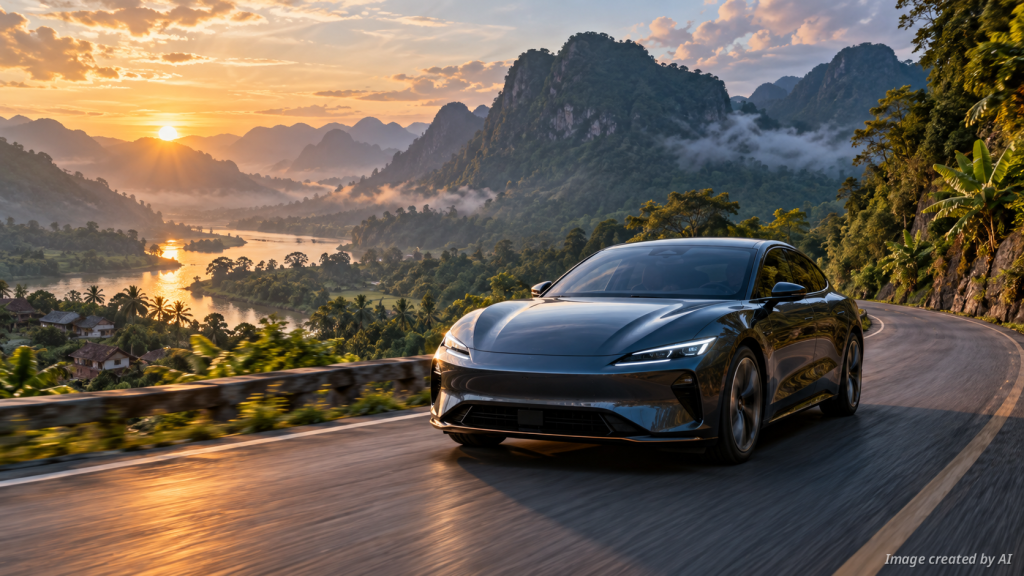
Currently, the use of electric vehicles (EVs) has become a rapidly growing mainstream trend in the Lao PDR. Many consumers are beginning to take an interest in vehicles that use clean energy to reduce the burden of rising fuel costs [2]. Beyond the savings, environmental conservation factors have also contributed to the widespread popularity of electric vehicles [1].
This shift is not just about technology; it is also about creating a new travel culture. The EV user community in Laos has begun actively exchanging experiences through social media [3]. Many users have also shared stories of long-distance trips that demonstrate the efficiency of electric vehicles on Lao road conditions [4].
Growth of the EV User Community
As the number of users increases, online communities have become an essential space for providing advice. New users often look for information regarding home charger installation and locating public charging stations. Exchanging this information helps build confidence for those who are still hesitant about switching to electric vehicles. Electric vehicles in Laos have become a hot topic of conversation.
Furthermore, there are user groups that organize long-distance travel activities together. They prove that electric vehicles can travel between provinces confidently if well-planned [4]. These experiences are documented in Facebook groups and various discussion forums, which serve as invaluable sources of information. You can learn more about discovering new experiences in Laos through sustainable tourism.
Government Policies and Support
The Lao government has implemented several measures to encourage the use of electric vehicles. A strategy for clean energy development in the transport sector has been clearly planned through 2050 [2]. This promotion includes tax reductions and the facilitation of imports [1].
Transitioning to 100% electric vehicles in some sectors remains a challenging goal. However, with the country's existing hydroelectric potential, Laos has a significant advantage [3]. You can read more information about becoming an electric vehicle nation to see future directions.
EV Maintenance Culture
Owning an electric vehicle requires a different technical understanding than a gasoline vehicle. The user community often advises each other on how to maintain the battery for a long lifespan. Modern software systems in electric vehicles allow users to easily check the status of the vehicle [4].
Moreover, sharing knowledge about charging is also an important culture. Users often recommend stations with fast charging speeds and ease of use. You can study more about using artificial intelligence in electric vehicle battery management to upgrade your knowledge.
The Future of Travel in Laos
In the future, we will see more extensive infrastructure development. Not only in major cities, but charging stations will spread to various tourist areas [3]. This will help make traveling by electric vehicle a normal occurrence for everyone.
This change will have a tremendous positive impact on the nation's economy and environment [5]. With support from both the government and the enthusiasm of the community, Laos is moving toward a new era of clean and sustainable transportation. You can follow more news about policies promoting electric vehicles to be part of this change.
More Information
- Electric Vehicle (EV): A vehicle powered by an electric motor instead of an internal combustion engine, using energy from a rechargeable battery, helping to reduce emissions and air pollution.
- Clean Energy: Energy sources derived from nature, such as hydropower, solar, or wind, which have less impact on the environment than fossil fuels.
- Charging Station: A facility established to provide charging services for electric vehicles, featuring both slow and fast charging to meet the needs of users during their travels.
- Online Community Culture: The gathering of groups with similar interests on social media to exchange information, experiences, and assist each other in solving various problems related to electric vehicle usage.
- Sustainable Transportation: A form of travel that considers long-term environmental, social, and economic impacts so that future generations can continue to utilize resources.